
In the modern academic landscape, the boundaries between disciplines are dissolving. Musicians are coding synthesizers, and software engineers are writing philosophical treatises on artificial intelligence. At the heart of this intersection lies algorithmic thinking—a disciplined approach to problem-solving that is traditionally associated with computer science but is becoming the “secret sauce” for high-level technical research writing. For undergraduate students navigating the rigors of university life, adopting a programmer’s mindset can turn a chaotic writing process into a streamlined, high-output system.
Writing a technical paper is often viewed as a creative struggle, but it is more accurately described as an engineering challenge. When you approach a research project, you aren’t just “writing”; you are architecting information. By applying the principles of decomposition, pattern recognition, and abstraction, students can produce work that is not only logically sound but also highly persuasive to academic examiners and global audiences. Whether you are documenting a new software tool or analyzing a complex social trend, the logic of the algorithm ensures your message is never lost in the noise.
Bridging the Gap: Logic, Data, and Academic Support
One of the biggest hurdles for undergraduates is the sheer volume of data involved in modern assignments. It is easy to feel overwhelmed by the need to synthesize dozens of sources while maintaining a coherent argument. This is where modularity comes into play. Just as a developer writes functions to handle specific tasks, a student should view each section of their paper as a “module” designed to solve a specific part of the research question. Managing this workload is a skill in itself, and many high-achieving students recognize when they need to optimize their workflow. For instance, when deadlines stack up, using a cheap assignment writing service can provide the structural templates and foundational research necessary to keep a project on track without sacrificing quality or logical flow.
The Core Pillars of Algorithmic Research Writing
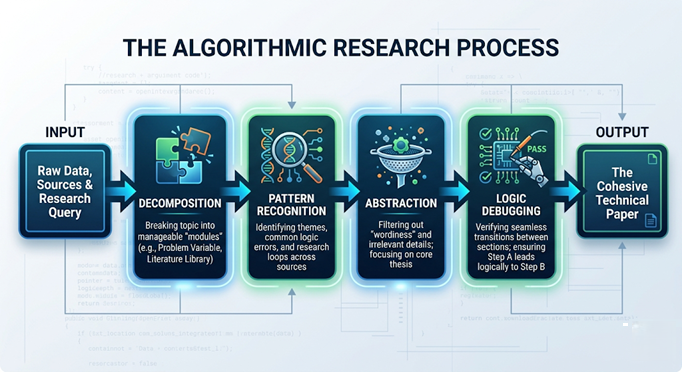
To understand how to write like an “architect,” we must break down the four pillars of computational thinking and apply them directly to the page.
1. Decomposition: Breaking Down the Monster
In programming, you never write a 10,000-line program in one go. You break it into small, manageable functions. Technical writing should be the same. Instead of “Writing a Thesis,” your tasks should be “Defining the Problem Variable,” “Auditing the Literature Library,” and “Debugging the Conclusion.” When you decompose a research paper, the “blank page syndrome” disappears because you are only ever working on one small, logical unit at a time.
2. Pattern Recognition: Finding the Narrative Trend
Good researchers are essentially pattern-matching engines. They look at a hundred different papers and see the common threads. In your writing, this means identifying how different scholars approach the same problem. Are there recurring flaws in their logic? Is there a “loop” in the current research that hasn’t been closed? Recognizing these patterns allows you to position your own work as the missing piece of the puzzle.
3. Abstraction: Removing the Fluff
Abstraction is the process of filtering out unnecessary details to focus on the core logic. In a research paper, this is the difference between a “wordy” student and a “precise” scholar. An algorithmic writer asks: “Does this sentence provide necessary data for the conclusion, or is it just noise?” If it doesn’t serve the “program” (the thesis), it gets deleted.
4. Algorithm Design: The Step-by-Step Argument
This is your outline. A well-designed research paper follows a linear, logical path where “Step A” must be true for “Step B” to function. If your logic jumps from the introduction to a conclusion without the necessary “processing” in the middle, the reader’s brain will return a “syntax error.”
Comparison: Traditional Writing vs. Algorithmic Writing
| Feature | Traditional Writing Approach | Algorithmic Writing Approach |
| Organization | Chronological or random thoughts | Modular and hierarchical |
| Revision | Correcting grammar at the end | Continuous “debugging” of logic |
| Data Usage | Quoting sources to fill space | Using data as “inputs” to prove a point |
| Clarity | Often relies on complex vocabulary | Prioritizes “code readability” (logic) |
| Focus | Finishing the word count | Solving the research problem |
Engineering the High-Level Research Paper
As you move into advanced technical subjects—be it Engineering, Medicine, or Law—the stakes for accuracy increase. You are no longer just reporting facts; you are synthesizing new knowledge. This requires a deeper level of “Information Gain,” a concept search engines like Google use to rank content. To rank high in the eyes of an academic board (or a search algorithm), your paper must offer a perspective that isn’t just a rehash of what is already online.
This level of synthesis is difficult. It requires a mastery of “Technical Literacy”—the ability to explain complex data in a way that a human can understand. Many students find that while they have the ideas, they lack the formal “syntax” required for high-tier academic journals. This is precisely why many researchers look for expert assistance to refine their drafts. If you are struggling to synthesize your data into a cohesive narrative, you might choose to write my research paper for me through a specialized consultant at MyAssignmentHelp. This approach allows you to see how professional academic architects structure arguments, cite complex sources, and maintain a global tone that resonates with international scholars.
The “Syntax” of a Global Tone
In a globalized academic world, your writing must be accessible to someone in London, New York, or Dubai. This means avoiding local idioms and “slang” in favor of clear, universal terminology.
- Avoid: “This theory is a slam dunk.”
- Use: “This theory provides a robust framework for further analysis.”
By treating your language as a “standardized API,” you ensure that your research can be integrated into the wider scientific community without translation errors.
Conclusion: The Future of Academic Output
Algorithmic thinking isn’t about turning humans into robots. It’s about using the most efficient logical frameworks available to amplify human creativity. When you treat your research paper like a piece of high-quality software—modular, debugged, and logically sound—you produce work that stands the test of time.
By applying these computational principles, you ensure that your writing is not just a collection of words, but a functional tool that solves problems and advances knowledge. Whether you are using MyAssignmentHelp to polish your final draft or building your thesis from scratch using modular logic, the goal remains the same: clarity, authority, and impact.
Frequently Asked Questions (FAQ)
Q.1. Does algorithmic thinking mean I should use AI to write my paper?
Ans: No. Algorithmic thinking is a human mental process. It’s about how you organize your thoughts and structure your logic. While AI tools can assist, the “architecture” of the argument must come from your own critical analysis to ensure academic integrity.
Q.2. How does this approach help me rank better on Google or academic databases?
Ans: Search engines and academic databases both prioritize “Information Gain” and logical structure. By using clear headings, modular sections, and unique insights (rather than fluff), you make it easier for both algorithms and humans to identify your work as authoritative.
Q.3. Is it okay to use professional help for my assignments?
Ans: Yes, many students use services as a learning tool. Seeing a professionally structured paper can help you understand the “syntax” of academic writing, which you can then apply to your own future work. It’s about improving your own “technical literacy.”
Q.4. What is the most important part of “debugging” a research paper?
Ans: The most critical step is checking the transition between paragraphs. If the conclusion of Paragraph A doesn’t naturally lead to the “input” of Paragraph B, the logic is broken. Always read your work to see if the “flow” makes sense to someone who isn’t an expert in your topic.
About The Author
Hello, I’m Lucy Wilson. As a senior academic consultant and content strategist at MyAssignmentHelp, I specialize in bridging the gap between complex theoretical frameworks and professional career readiness.