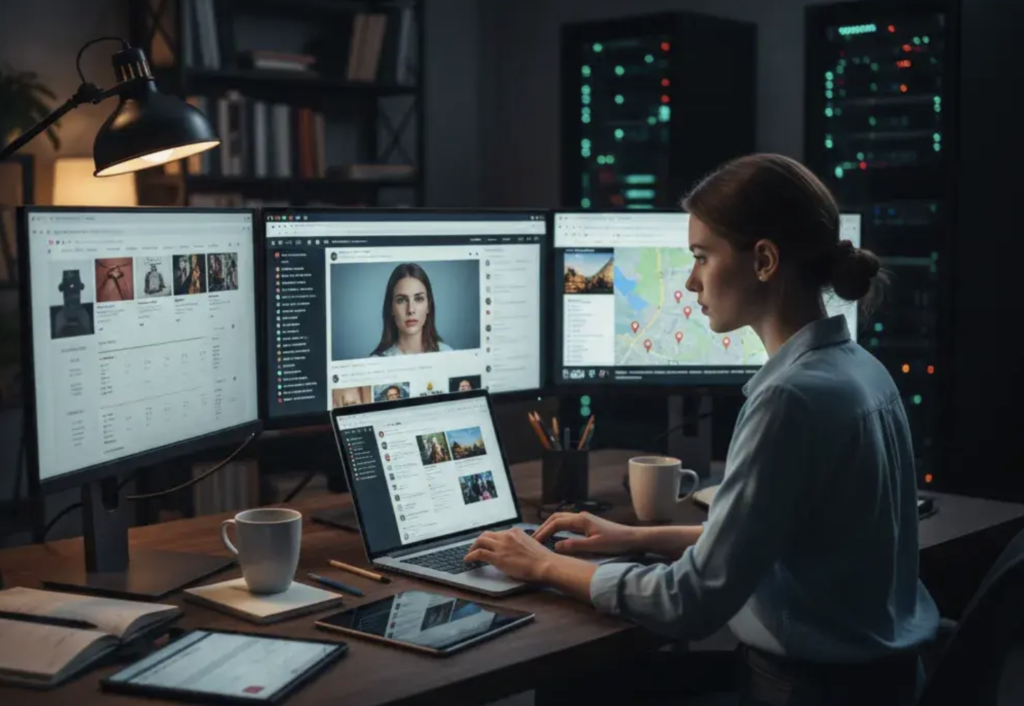
Background checks have always relied on names, social security numbers, and database lookups. But a growing number of companies are adding a new layer to their verification process — searching a candidate’s photo to confirm their identity before making hiring decisions.
AI-powered photo search, sometimes called face search or reverse face lookup, uses facial recognition to find every publicly available instance of a person’s face across the internet. This goes beyond what traditional background check services offer, revealing whether a candidate’s photo matches their claimed identity or if their headshot appears on other profiles under different names.
The shift toward photo-based verification reflects a broader reality: identity fraud in hiring is increasing, and names alone are no longer enough.
The Problem Traditional Background Checks Miss
Standard background check services — platforms like Checkr, GoodHire, or Sterling — search criminal databases, credit reports, and employment records using personal identifying information. These services are effective at finding documented records, but they have a blind spot: they assume the person being searched is who they claim to be.
This assumption is increasingly problematic. Remote hiring has created opportunities for identity fraud that barely existed a decade ago. Candidates can submit fabricated resumes with stock photo headshots, use stolen identities to pass name-based checks, or create entirely fictitious professional personas.
A 2025 report from the Society for Human Resource Management found that approximately 22% of job applicants misrepresent themselves in some material way. While most misrepresentations involve embellished qualifications, a growing subset involves outright identity fraud — particularly in remote positions where in-person verification never occurs.
How Photo-Based Verification Works
The process is straightforward. An HR professional takes the candidate’s headshot — typically from their resume, LinkedIn profile, or application — and uploads it to a photo-based people search tool such as PeopleFinder. The AI analyzes the facial geometry and searches for that face across millions of publicly indexed images.
Within seconds, the system returns results showing where that face appears online. This might include social media profiles, news articles, professional directories, or public databases. The HR team can then cross-reference these results against the information the candidate provided.
If a candidate claims to be a marketing director named Sarah Johnson based in Chicago, but the face search reveals that their photo belongs to a fitness influencer in São Paulo — that is an immediate red flag.
Five Scenarios Where Photo Verification Adds Value
Remote hiring without in-person interviews. When every interaction happens over video call, confirming that the person on camera matches their application materials is essential. Photo search adds a verification layer that video alone cannot provide.
Executive-level recruitment. For senior positions involving significant authority and access to sensitive information, photo verification provides an additional due diligence step. Verifying that a candidate’s professional headshot matches their claimed background across multiple platforms adds confidence to high-stakes hiring decisions.
Freelancer and contractor vetting. The gig economy operates largely on trust. Before engaging a freelancer for sensitive work, a quick photo search can confirm that the person behind the profile has a consistent online presence matching their claimed identity.
International hiring. When hiring across borders, traditional background check services may have limited coverage in certain jurisdictions. Photo-based verification works globally, as it searches publicly available images regardless of geography.
Post-incident investigation. If an employee is suspected of misconduct or misrepresentation, photo verification can reveal previously undisclosed identities, affiliations, or activities associated with their face.
Implementation Considerations
Companies considering photo-based verification should address several practical and legal factors.
First, transparency with candidates is important. While searching publicly available images is generally permissible, many jurisdictions require informing candidates that a background check — including image-based verification — will be conducted. The Fair Credit Reporting Act in the United States and GDPR in the European Union both impose disclosure and consent requirements.
Second, photo verification should supplement rather than replace traditional background checks. It adds a visual identity layer but does not replace criminal record searches, employment verification, or reference checks.
Third, companies should establish clear policies about how photo search results are interpreted and used. A match with a personal social media account is expected. A match with a profile under a completely different name warrants further investigation but not automatic disqualification.
The Business Case
The cost of a bad hire is estimated at 30% of the employee’s annual salary, according to the U.S. Department of Labor. For senior positions, the figure can be significantly higher when factoring in lost productivity, team disruption, and potential security breaches.
Photo-based verification costs a fraction of this amount — often less than $10 per search — and takes seconds rather than days. For companies processing hundreds of applications, integrating photo verification into the screening workflow represents a minimal investment with significant risk reduction.
Looking Ahead
As remote work becomes the default rather than the exception, the need for reliable digital identity verification will only increase. Photo-based AI search fills a gap that traditional background checks were never designed to address — confirming that the person behind the application is who they claim to be, not just that the name on the resume has a clean record.
Companies that adopt this technology early gain a competitive advantage in hiring quality and security posture. Those that wait may find themselves increasingly vulnerable to the growing sophistication of identity fraud.
Frequently Asked Questions
What is a photo-based background check? A photo-based background check uses AI facial recognition to search a candidate’s headshot across publicly available images online, verifying that their photo matches their claimed identity across multiple platforms.
Is it legal to use photo search for hiring? In most jurisdictions, searching publicly available images is legal. However, employers should comply with applicable disclosure and consent requirements under laws such as the FCRA (US) and GDPR (EU).
How long does a photo background check take? Modern AI face search platforms return results in under 10 seconds. The entire verification process, including cross-referencing results, typically takes less than five minutes.
Can photo search replace traditional background checks? No. Photo search is a supplementary verification layer. It confirms visual identity but does not replace criminal record searches, employment history verification, or reference checks.