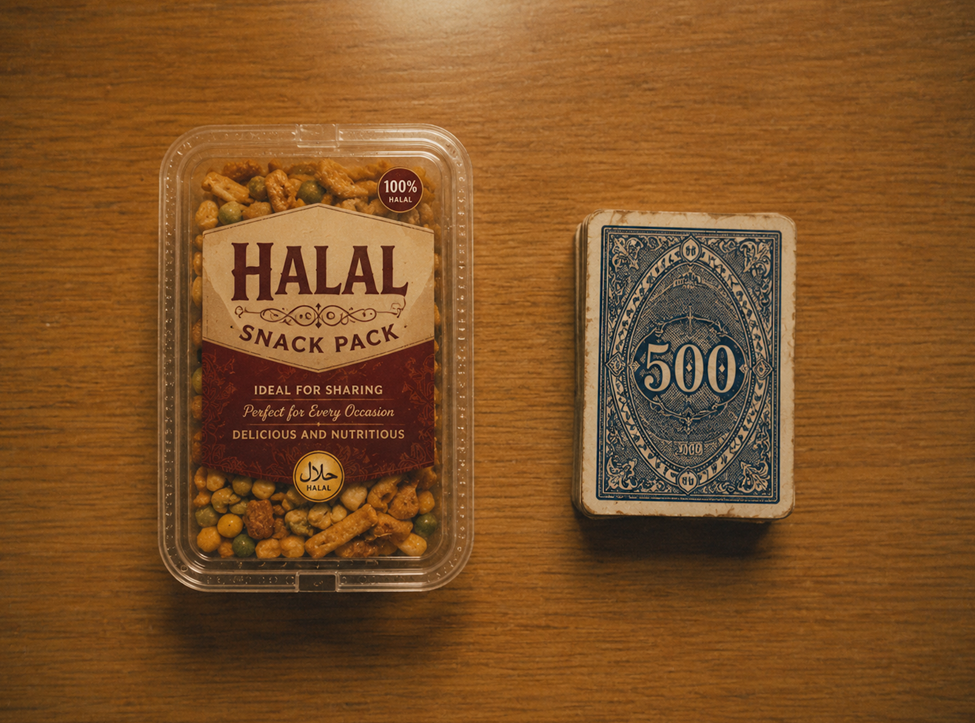
Both systems were designed to function under pressure, in company, with imperfect components and no margin for poor decision-making in the final stages. The card game 500 and the polystyrene box sitting open on someone’s kitchen bench at 1am are not typically discussed in the same analytical register. That says more about the limitations of existing frameworks than it does about the objects themselves.
The case for treating them as structurally equivalent rests on four points. The component architecture is layered and interdependent. Outcomes are determined by a single high-stakes decision made before full information is available. Execution quality varies enormously despite identical inputs. And neither experience exists in isolation from the people present when it happens.
The Component Architecture
A standard HSP arrives in layers. Hot chips form the base. Diced halal meat, typically lamb or chicken or a combination, goes on top. Then the sauces, and this is where the architecture becomes genuinely complex. The canonical three are garlic, chili, and BBQ. Each operates differently. Chili distributes heat. BBQ contributes sweetness and depth. Garlic does something else entirely, which will be addressed in full below.
The card game 500 operates on a comparable layered structure. A 45-card deck, a standard 52-card pack with the 2s through 6s removed and the Joker kept, is dealt ten cards each to four players in two partnerships, with five cards placed face-down in the centre as the kitty. The relevant structural point is that the game’s components are not equal in value and do not operate independently. Each card’s worth changes depending on what surrounds it, just as each HSP layer changes in character depending on what it sits against.
A chip at the bottom of the box, insulated from direct sauce contact, performs a different function than a chip at the top. The Jack of hearts performs a different function in a heart-trump hand than in a spade-trump hand. In the latter, it has defected entirely, becoming the Left Bower, third-highest trump, no longer a member of its printed suit for any purpose during that hand. The component has not changed. Its context has transformed it.
The Kitty and the Sauce Decision
The highest bidder in 500 takes the kitty, integrates those five unseen cards into their hand, discards back to ten, and declares trump. This is the pivotal decision point of the game. You have briefly held fifteen cards and must choose which ten represent your best available position. The discard is irreversible. The contract follows from it directly.
The sauce decision in an HSP operates under identical logic. At the point of ordering, the customer commits to a sauce configuration before the box is assembled and before the interaction between components can be assessed. You cannot un-add garlic sauce. You cannot redistribute chili after the meat has been placed. The order is declared, the box is constructed, and you play the hand you’ve created.
Poor discard decisions in 500 produce failed contracts despite strong initial holdings. Poor sauce decisions produce catastrophic HSPs despite using the same ingredients as a perfect one. The failure mode in both cases is not component quality but sequencing and proportion. A player who discards their only stopper in a critical suit hasn’t been dealt a bad hand. They’ve made a bad discard from a manageable one. A customer who requests all three sauces in equal quantities on a small box of chips hasn’t been given bad ingredients. They’ve made a structural error that no amount of quality meat can correct.
The Irreversibility Problem
Both systems share a specific feature: the moment of peak optionality passes quickly and cannot be recovered. In 500, once the discard is made and trump declared, the player is committed to the contract. In the HSP, once the box is closed and handed over, the configuration is fixed. Subsequent decisions, card play and eating strategy respectively, are responses to a structure already set by an earlier decision under incomplete information. Skill in the later stages matters, but it operates within constraints that were locked in before full information was available.
The Joker and the Garlic Sauce
The Joker is the highest card in 500. It belongs to no suit and owes allegiance to none. It outranks the Right Bower, which outranks the Left Bower, which outranks the Ace. It can be played whenever the holder chooses, subject to specific conditions around following suit. Its presence in a hand changes the calculus of every other card around it. A hand without the Joker is played differently than the same hand with it. When the Joker appears, something is resolved in a specific direction.
The garlic sauce is optional in theory. Once present in the box, it is dominant in practice. It redistributes across every other component regardless of initial placement. A box constructed without garlic sauce tastes like itself. A box with garlic sauce tastes like garlic sauce, with supporting notes of everything else. Its addition changes the calculus of every other sauce around it. A customer who adds garlic late, attempting to use it as one sauce among equals, discovers that it does not behave as one sauce among equals.
Both are technically optional. Neither is neutral once deployed.
Context, Timing, and the Conditions of Play
An HSP consumed at six in the evening is a meal. The same HSP consumed after midnight is a different thing entirely: a decision made at the end of a long sequence of other decisions, under conditions of reduced judgment, in company that has been together long enough to have developed strong views about sauce ratios. The box is identical. The experience is not.
500 is similarly context-dependent. The same hand plays differently at the start of a game, when risk tolerance is calibrated to the full distance ahead, than it does when one team sits on plus 430 and the other is approaching minus 400. The cards haven’t changed. The stakes have restructured every card’s meaning.
A game ends when one team reaches plus 500 or falls to minus 500, the latter an immediate loss with no further play. There is no equivalent terminal condition in the HSP, but anyone who has reached the bottom of a poorly constructed box, cold chips compressed under uneven meat distribution and excess sauce pooled in the corners, understands that certain configurations produce outcomes from which recovery is not possible.
The box is structural to the experience. So is the deal.